In house at Kinishi
Electronics and cable assemblies built in house
System electronics and cable assemblies are built by Kinishi in the UK, alongside the engineering team responsible for the product.

Axle weights, gross vehicle weight and payload, live in the cab — so the driver knows the load before the vehicle moves. Optional connected reporting carries it to the operation. Designed, manufactured and functionally tested by Kinishi in the UK.
Discuss a specialist application or partnership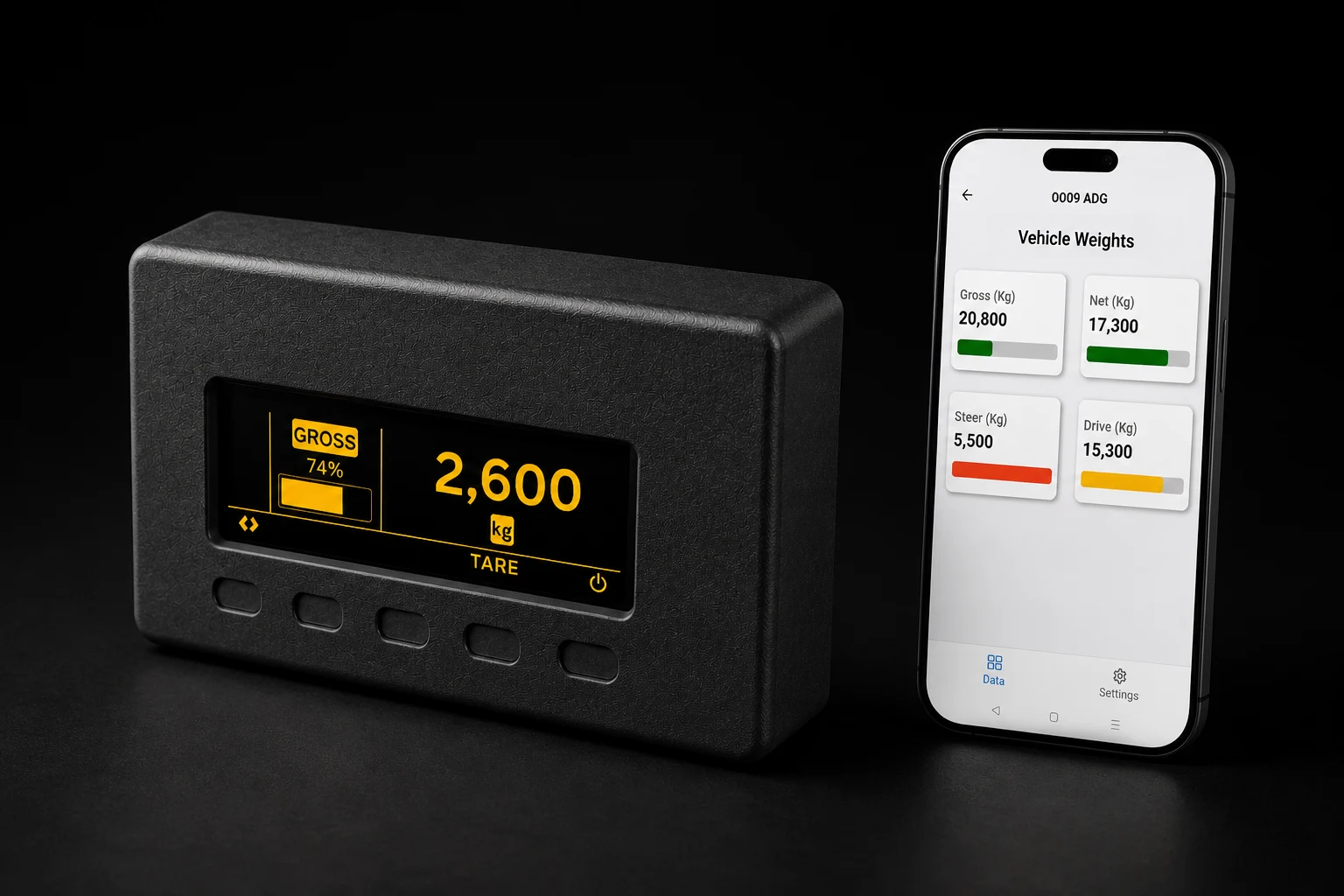
Current applications span commercial vehicles from 3.5-tonne cage tippers and vans to 44-tonne combinations, together with tanker, road-train, multi-trailer, forestry and agricultural-trailer configurations. The vehicle, body and suspension still determine the sensing and module arrangement.
Cage-tipper chassis used for municipal, landscaping, construction, recycling and maintenance work.
Commercial vans and light trucks used for delivery, trade, service, municipal and multi-drop operations.
Rigid vehicles for construction, aggregate, refuse, skip and hook-loader, municipal, recovery and distribution work.
Tanker chassis and trailers carrying fuel, chemicals, waste, water, food-grade products and other bulk liquids.
Tractor-trailer combinations including walking floors, bulk tippers, flatbeds, curtainsiders, low loaders and tanker work.
Road-train and multi-trailer configurations, with the axle, trailer, sensing and connection arrangement agreed through specification support.
Logging trucks, timber trailers and specialist forestry vehicles for collection, haulage and mill delivery.
Farm trailers carrying grain, silage, livestock, root crops and mixed agricultural loads.
Fleet, build or specialist application — you're not choosing between products. One physical system connects sensing, modules and the core unit the driver reads — on a display or in the Onboard app — with optional reporting beyond the vehicle; what changes is where you meet it.
The shared physical system uses a single 2-core cable running the length of the vehicle. Standard modules tap off it wherever the vehicle configuration requires.
The driver reads the load in the cab; the operation sees the same information through connected reporting — one system, one set of numbers.
Sensors and modules are chosen for the vehicle and suspension — and the single-cable architecture lets them sit wherever the build puts them.
Your market and application knowledge, carried on Kinishi hardware, firmware and reporting — with responsibilities agreed for each application.
The system is designed, manufactured and functionally tested by Kinishi in the UK. Electronics manufacture and test happen alongside the engineering team, so what production reveals reaches the people who design the system.
System electronics and cable assemblies are built by Kinishi in the UK, alongside the engineering team responsible for the product.
Every system receives a full functional end-of-line test before despatch.
Components are sourced from manufacturers or franchised distributors. Kinishi does not use grey-market parts.
Connected reporting is the optional reporting layer of the weighing system, which works on its own without it. When the operation needs the data, each vehicle's weights, trips and events go to one fleet portal, with PDF and CSV export and API access, from the same team that designs the hardware and firmware.
Explore connected reportingEvery installation is built from the same parts: one core unit, the sensor input modules for the vehicle's sensing method, and extension modules where the application needs them — all on one system cable.Whatever the combination, there's one thing to configure: the core unit.Every unit is IP67-rated except Core Display, which lives in the cab.
Every system has one core unit: it takes the sensor inputs and calculates axle, gross and payload weights. All three connect wirelessly to the Onboard mobile app, for reading the load and configuring the system.
The core unit on its own — the driver reads the load in the Onboard app.
The core unit with an integrated OLED display — the in-cab unit the driver reads.
The core unit with connected reporting built in.
One module per sensing method. Sensors are chosen for the vehicle, suspension and application; the input module connects them to the system.
Connects solid-state sensors used to measure load-related movement in mechanical or leaf-spring suspension systems.
Connects air-pressure or hydraulic-pressure sensors to the system.
Connects load-cell sensors to the system.
Add connectivity, switched outputs or tilt compensation where required.
Adds connected reporting to Core or Core Display.
Switched outputs that let the vehicle respond to load — warning lamps, strobes or signals to other systems.
Corrects the weight reading for the angle the vehicle is standing at.
One system cable runs the length of the vehicle; every unit taps off it.
System cable, bus tee connectors for each tap-off and 7-pole 24N trailer connectors for flexible, coiled Susie cable connections.