
Onboard weighing for bodybuilders and installers

A system designed to be specified, installed and supported around a real vehicle build.

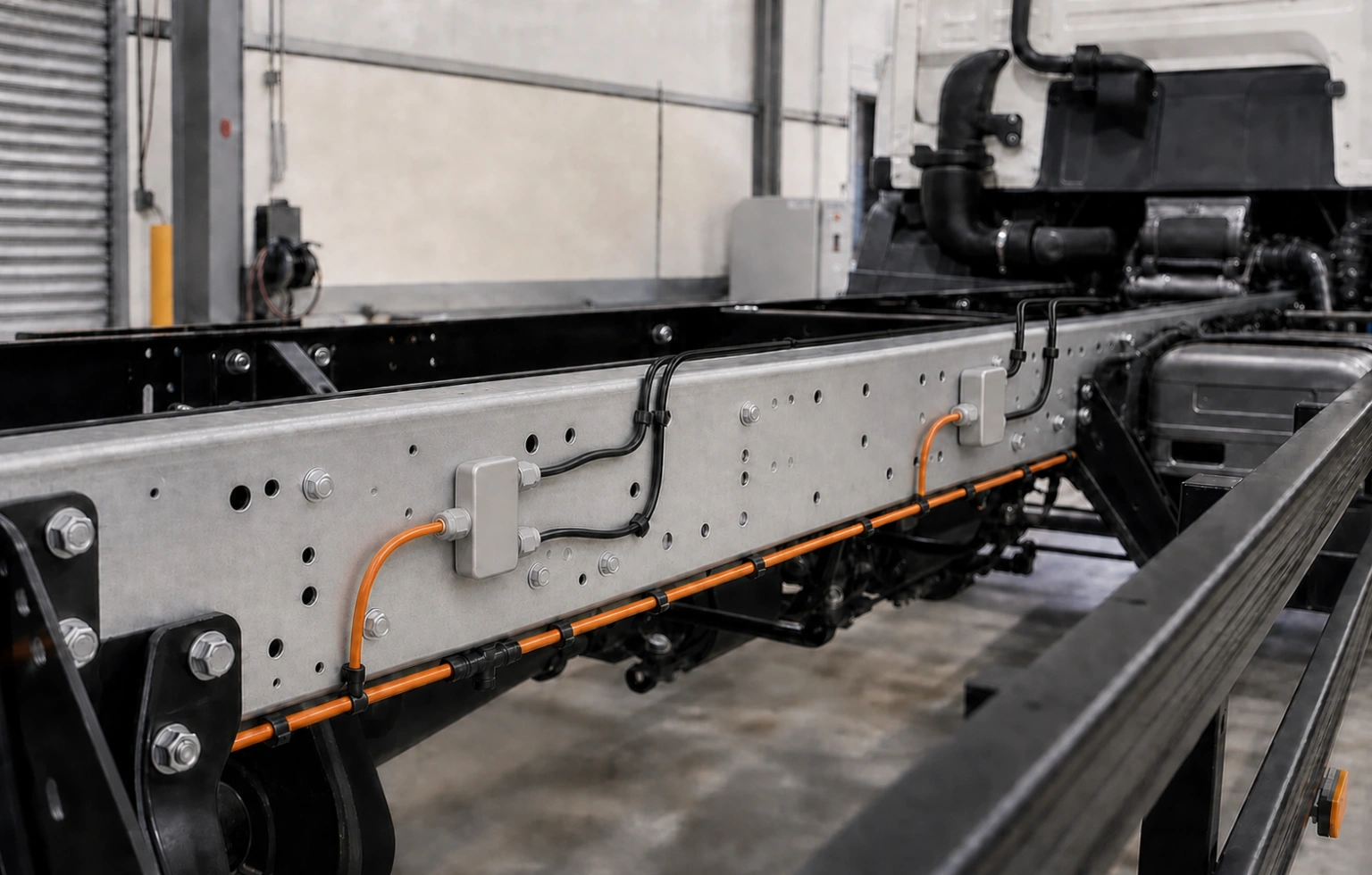
The architecture is visible before you commit to it. One 2-core cable runs the length of the vehicle, and the agreed system modules tap off that cable wherever required.

Illustrative commercial-vehicle chassis with aluminium sensor input modules, a single orange bus cable and black sensor leads

The same architecture on every vehicle.

Whatever the vehicle, the pattern is the same: one 2-core cable runs its full length, and system modules tap off it wherever the agreed configuration requires them. Only the sensing and module arrangement changes — so every build follows the same repeatable path from specification to commissioning.

Concept architecture · simplified, not a wiring diagram

Example shows: different sensors at the front & rearMechanical suspension uses solid-state sensors and air suspension uses pressure sensors.

For the bodybuilder and specifier

Begin with the vehicle, suspension and application. Kinishi engineering reviews the sensing arrangement, module configuration and interfaces before the build proceeds.

  • Vehicle first. The suspension and application inform the sensing arrangement.
  • Defined configuration. Module positions and electrical and physical interfaces are agreed for the build.
  • Reporting when required. Connected reporting can extend vehicle weight information beyond the cab.

For the installer and commissioning team

The physical route begins with one 2-core cable along the vehicle. Modules connect to that route at the positions defined for the agreed configuration.

  • One longitudinal route. Power and system communication share the same cable.
  • Modules where required. Each module taps into the cable at its agreed position.
  • Information for the job. Current dimensions, electrical requirements and commissioning information support the build.

Prepare a configuration request.

Three areas shape the first review. Share what is known; Kinishi engineering confirms the final module combination, quantities, positions and physical route for the live vehicle specification.

Suspension and sensing

Record the vehicle’s suspension or sensing arrangement: mechanical or leaf-spring, air or hydraulic, direct measurement, or a mixture.

Driver information and reporting

Describe where weight information is needed: in the Onboard app, on an integrated in-cab display, through connected reporting, or in a combination of these.

Vehicle interfaces

Identify any warning lamps or signals, requirement for weight correction when the vehicle is standing at an angle, and separable tractor, trailer or drawbar connections.

What to send

Include the vehicle or chassis, body and application, suspension arrangement, driver and reporting requirements, external outputs or trailer connections, and any available drawings.

Built and tested by the people who designed it.

The system is designed, manufactured and functionally tested by Kinishi in the UK. Electronics manufacture and test happen alongside the engineering team, so what production reveals reaches the people who design the system.

In house at Kinishi

Electronics and cable assemblies built in house

System electronics and cable assemblies are built by Kinishi in the UK, alongside the engineering team responsible for the product.

Standard on every system

Full functional end-of-line test

Every system receives a full functional end-of-line test before despatch.

Manufacturer or franchised source

Controlled component sourcing

Components are sourced from manufacturers or franchised distributors. Kinishi does not use grey-market parts.


Connected reporting, when the application needs it.

Connected reporting is an optional extension for applications that need vehicle weight information beyond the cab. The exact reporting and integration requirement is reviewed as part of the application.

Explore connected reporting
Vehicle systemWeight information in the cab
Reporting layerExtends the information path
Operational useDefined for the application
Concept data path · reporting detail and screens will follow confirmed product information

Vehicle and application examples.

These examples show the vehicle and application range already covered by current systems. They are a starting point for specification, not confirmation that every chassis, body and suspension variant uses the same configuration.

Light-commercial cage tippers3.5 tonnes

Cage-tipper chassis used for municipal, landscaping, construction, recycling and maintenance work.

  • Ford Transit Tipper
  • Renault Master Tipper
  • Isuzu Grafter / N35
  • Iveco Daily Tipper
  • Mercedes Sprinter Tipper
  • Peugeot Boxer Tipper
  • VW Crafter Tipper
  • Citroen Relay Tipper
Vans and light trucks3.5–7.5 tonnes

Commercial vans and light trucks used for delivery, trade, service, municipal and multi-drop operations.

  • Ford Transit
  • Mercedes Sprinter
  • VW Crafter
  • Iveco Daily
  • Renault Master
  • Peugeot Boxer
  • Citroen Relay
  • MAN TGE
Rigid trucks and HGVs7.5–32 tonnes

Rigid vehicles for construction, aggregate, refuse, skip and hook-loader, municipal, recovery and distribution work.

  • DAF LF
  • DAF CF
  • MAN TGL / TGM
  • Mercedes Atego
  • Mercedes Actros
  • Scania P / G / R
  • Volvo FE / FH
  • Iveco Eurocargo
TankersRigid and articulated

Tanker chassis and trailers carrying fuel, chemicals, waste, water, food-grade products and other bulk liquids.

  • DAF CF
  • DAF XF
  • Mercedes Actros
  • Volvo FH / FM
  • Scania P / G / R
  • MAN TGX / TGS
  • Renault T-High
  • Iveco S-Way
Articulated vehiclesUp to 44 tonnes

Tractor-trailer combinations including walking floors, bulk tippers, flatbeds, curtainsiders, low loaders and tanker work.

  • DAF XF / XG
  • Mercedes Actros
  • Volvo FH / FH16
  • Scania R / S Series
  • MAN TGX
  • Renault T-High
  • Iveco S-Way
  • DAF CF (artic specification)
Road trains / multi-trailer vehiclesMulti-trailer combinations

Road-train and multi-trailer configurations, with the axle, trailer, sensing and connection arrangement agreed through specification support.

  • Road trains
  • Multi-trailer vehicles
Forestry and loggingTrucks and trailers

Logging trucks, timber trailers and specialist forestry vehicles for collection, haulage and mill delivery.

  • Volvo FH / FH16
  • Scania R / G Series
  • Mercedes Actros / Arocs
  • MAN TGX / TGS
  • DAF XF / CF
  • Iveco T-Way
  • Renault K-Range
  • Specialist forestry trailers
Agricultural trailersSingle, twin and tri-axle

Farm trailers carrying grain, silage, livestock, root crops and mixed agricultural loads.

  • Grain trailers
  • Silage trailers
  • Livestock trailers
  • Root-crop / potato trailers
  • Chaser bins
  • Dump trailers
  • Tandem-axle trailers
  • Tri-axle trailers

Next steps

Review a configuration for a live build.

Share the vehicle, suspension, application and available drawings with Kinishi engineering.

Request specification support

Assess the system for a vehicle or fleet requirement.

Bring the application, vehicle context and what the evaluation needs to establish.

Explore evaluation

Discuss a requirement outside a standard vehicle route.

Start with the application, interfaces and responsibilities that need to be understood.

Discuss the application